 The Runner Story

HIIT vs Steady-State Cardio: Building Marathon Endurance
Training for a marathon demands endurance that lasts 26.2 miles. Two popular methods dominate cardio workouts: High-Intensity Interval Training (HIIT) and steady-state cardio. HIIT involves short bursts of all-out effort followed by recovery, while steady-state cardio is longer, moderate-paced sessions. But which builds better marathon endurance? We'll break down pros, cons, scientific evidence on VO2 max gains and fatigue resistance, then recommend a hybrid approach with a sample 4-week progression for intermediate runners eyeing 2026 marathons.
What is HIIT and Steady-State Cardio?
HIIT alternates intense efforts (e.g., 30-60 seconds at 90-100% max heart rate) with recovery periods. A typical session: 4x4-minute intervals at high effort with 3-minute jogs.
Steady-state cardio maintains a consistent moderate intensity (60-70% max heart rate) for 30-90+ minutes, like a long temple run.
Marathon endurance relies on aerobic capacity (VO2 max), lactate threshold, and fatigue resistance—the ability to sustain effort despite accumulating fatigue.
Pros and Cons of HIIT for Marathon Training
Pros:
- Time-efficient: 20-40 minute sessions yield big gains.
- VO2 max boost: Explosive intervals spike oxygen uptake.
- Fatigue resistance: Mimics race surges, improving economy.
- Metabolic perks: Burns fat post-workout (EPOC effect).
Cons:
- High injury risk: Intense impacts stress joints.
- Recovery demands: Can lead to overtraining if overdone.
- Limited volume: Hard to replicate marathon's hours-long effort.
Pros and Cons of Steady-State Cardio
Pros:
- Endurance specificity: Builds exact aerobic base needed for marathons.
- Fatigue adaptation: Teaches body to handle prolonged effort.
- Lower injury risk: Sustainable pace reduces strain.
- Mental toughness: Preps for race monotony.
Cons:
- Time-consuming: 60-120+ minutes per session.
- Slower VO2 max gains: Less intensity limits peak capacity.
- Plateau risk: Body adapts quickly without variety.
Scientific Evidence: VO2 Max and Fatigue Resistance
Research favors a mix. A meta-analysis shows HIIT improves VO2 max by 5-10% in trained athletes, outperforming steady-state by 2x in less time. For example, 4x4-minute intervals match hours of moderate running for aerobic gains.
Steady-state excels in fatigue resistance. Studies on endurance athletes reveal long runs enhance mitochondrial density and capillary growth, key for sustaining marathon pace.
Check PubMed for studies like Helgerud et al. (2007), showing HIIT's VO2 max edge. The American College of Sports Medicine (ACSM) endorses polarized training—80% easy steady-state, 20% high-intensity—for optimal endurance without burnout.
Hybrid approaches shine: A Norwegian study found combining both yielded superior lactate threshold and economy vs. either alone.
Why a Hybrid Schedule for 2026 Marathon Training?
Pure HIIT risks burnout; pure steady-state stalls progress. A hybrid optimizes VO2 max (HIIT), fatigue resistance (steady-state), and specificity. For intermediate runners (half-marathon under 2 hours), aim for 80/20 rule: 80% low-intensity steady-state, 20% HIIT/threshold.
Periodize for 2026: Build base with steady-state (fall 2025), add HIIT peaks (winter), taper pre-race (spring 2026). Total weekly volume: 40-60 miles, 4-5 runs.
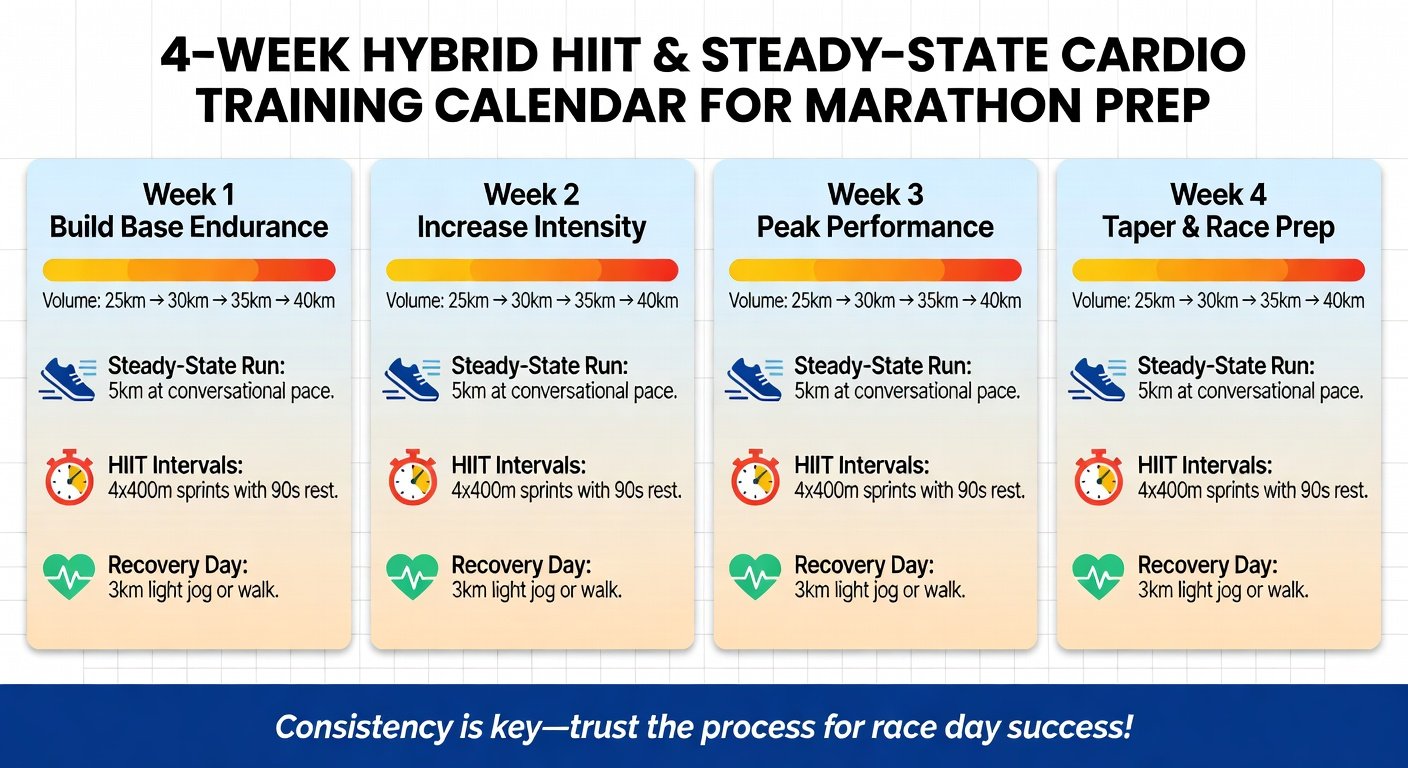
Sample 4-Week Hybrid Progression for Intermediates
This progression assumes 45-55 miles/week base. Warm-up/cool-down: 10-15 min easy. Rest or cross-train other days. Adjust paces: Easy (conversational), Marathon (goal pace), HIIT (hard effort).
Week 1: Base Building
- Monday: Rest
- Tuesday: 6 miles steady-state easy
- Wednesday: HIIT - 6x400m @ 5K pace, 2-min jog recovery (total 8 miles)
- Thursday: 5 miles easy + strides
- Friday: Rest
- Saturday: 12 miles steady-state marathon pace
- Sunday: 6 miles recovery
Week 2: Intensity Ramp
- Monday: Rest
- Tuesday: 7 miles steady-state
- Wednesday: HIIT - 5x800m @ 10K pace, 3-min jog (total 9 miles)
- Thursday: 6 miles easy
- Friday: Rest
- Saturday: 14 miles steady-state w/ last 4 @ marathon pace
- Sunday: 7 miles recovery
Week 3: Volume Peak
- Monday: Rest
- Tuesday: 8 miles steady-state
- Wednesday: Threshold - 20 min @ half-marathon pace in 10-mile run
- Thursday: 7 miles easy + drills
- Friday: Rest
- Saturday: 16 miles steady-state
- Sunday: 8 miles recovery
Week 4: Recovery/Deload
- Monday: Rest
- Tuesday: 5 miles easy
- Wednesday: HIIT - 4x1-min hill repeats (total 7 miles)
- Thursday: 4 miles easy
- Friday: Rest
- Saturday: 10 miles steady-state easy
- Sunday: 5 miles recovery
Track progress with weekly time trials (e.g., 5K). Fuel with carbs, prioritize sleep, and listen to your body to avoid burnout.
Final Recommendation
For 2026 marathon success, hybrid is king. HIIT turbocharges VO2 max and speed; steady-state forges unbreakable fatigue resistance. Start this 4-week block now, scale up, and you'll cross that finish line stronger. Consult a coach for personalization.


No comments yet. Be the first!