 The Runner Story

Why Zone 2 Training is the Foundation of Marathon Success
Preparing for a 2026 marathon? Whether it's Boston, New York, or your local race, building a strong aerobic base is non-negotiable. Enter Zone 2 training—the steady, sustainable effort level that forms the bedrock of endurance. Unlike high-intensity intervals, Zone 2 focuses on low-to-moderate heart rates where your body efficiently burns fat for fuel, enhances mitochondrial density, and reduces injury risk. Elite marathoners like Eliud Kipchoge spend up to 80% of their training here. In this guide, we'll break down how to find your Zone 2 heart rate, sample weekly plans progressing toward race day, and pro tips to optimize your prep.
Understanding Heart Rate Zones and Zone 2
Heart rate zones divide your effort into five levels based on maximum heart rate (HRmax) or lactate threshold heart rate (LTHR). Zone 2 typically sits at 60-70% of HRmax or 76-86% of LTHR—conversational pace where you can speak full sentences but feel a gentle burn.
This zone maximizes aerobic development without accumulating excessive fatigue. It's the 'easy' run that pays big dividends over months.
Scientific Benefits of Zone 2 Training
Zone 2 isn't just feel-good running; it's backed by physiology. Here's why it shines for marathoners:
- Fat Oxidation: At Zone 2 intensities, your body shifts to burning fat over glycogen, sparing carbs for race day. Studies show trained athletes oxidize up to 1.5g/min of fat here, extending endurance. For more on training physiology, check TrainingPeaks.
- Mitochondrial Efficiency: Regular Zone 2 boosts enzyme activity and capillary density, improving oxygen delivery.
- Injury Prevention: Low stress on joints and muscles allows higher weekly volume (80-120 miles) with recovery. Research links polarized training (80% Zone 2, 20% high-intensity) to fewer overuse injuries.
- Metabolic Flexibility: Enhances your ability to switch fuels, key for the marathon's later miles.
Coaches like Stephen Seiler advocate polarized models, proven in endurance sports for superior VO2max gains and performance.
How to Calculate Your Zone 2 Heart Rate
Skip generic formulas like '220-age.' Accurate zones require testing. Two reliable methods:
Lactate Threshold Test (Gold Standard)
Best done in a lab, but field approximations work. Warm up, then run 30 minutes all-out. Your average HR in the last 20 minutes is LTHR. Zone 2 is LTHR minus 12-20 bpm (or 76-86%). Labs use blood lactate; for home, use perceived effort.
Field Tests for Everyday Runners
No lab? Try these:
- Talk Test: Run at a pace where you can recite a paragraph comfortably but singing is tough. Monitor HR—that's your upper Zone 2.
- 30-Minute Time Trial: Warm up 10 min, run steady 30 min. Average HR from minutes 10-30 approximates LTHR.
- MAF Method (Phil Maffetone): 180 - age, adjust for fitness (+5 if improving, -5 if injured). Run here exclusively initially.
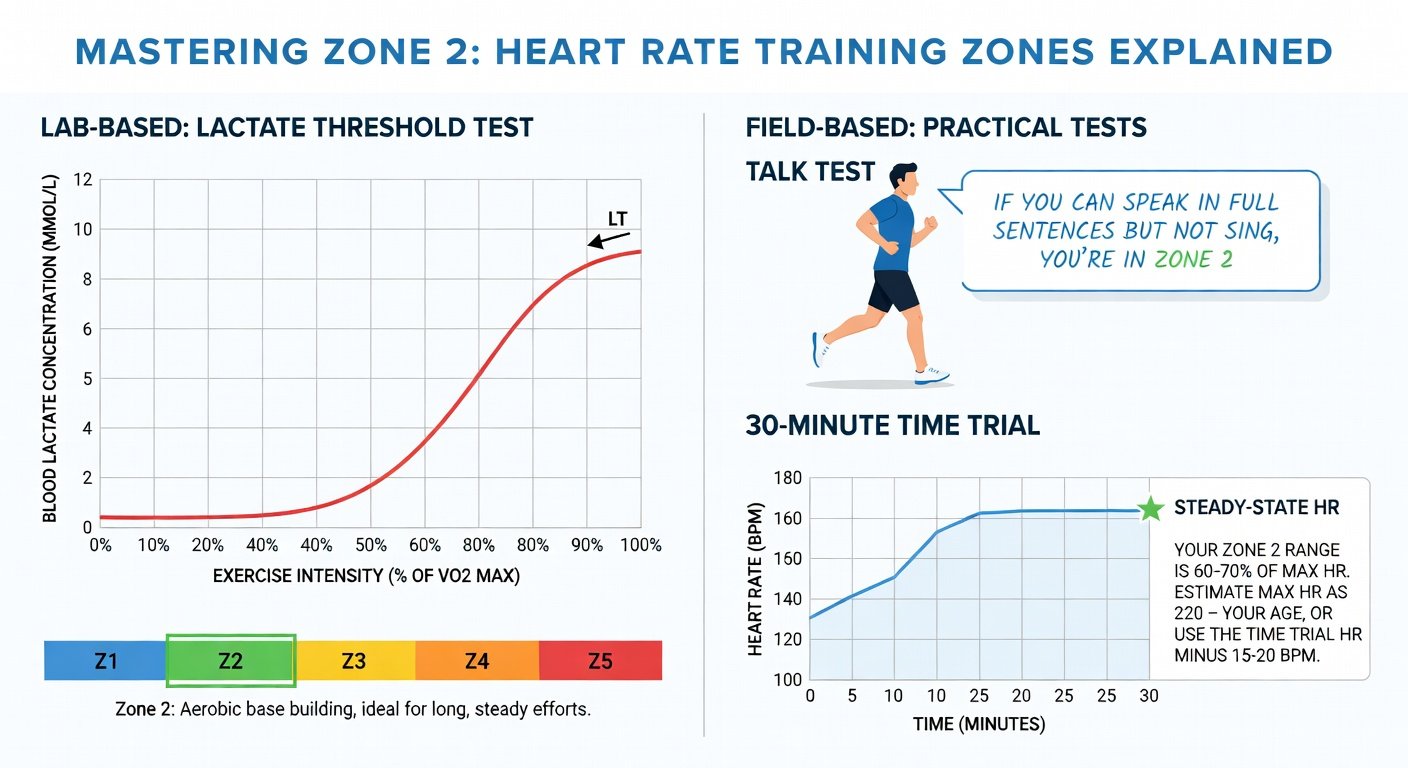
Track with a chest strap like Garmin or Polar for precision. Retest every 4-6 weeks as fitness improves. Runner's World offers more on heart rate training.
Sample Weekly Schedules for 2026 Marathon Training
Target races like London (April) or Chicago (October)? Build from base (16+ weeks out) to peak. Assume 40-60 miles/week intermediate; scale for beginners.
Base Phase (16-12 Weeks Out)
- Monday: Rest or yoga
- Tuesday: 45-60 min Zone 2
- Wednesday: 60 min Zone 2 + strides
- Thursday: 45 min easy
- Friday: Rest
- Saturday: 90 min Zone 2 long run
- Sunday: 60-75 min Zone 2
Total: 25-35 miles. Focus 80% Zone 2.
Build Phase (12-8 Weeks Out)
- Monday: Rest
- Tuesday: 60 min Zone 2 + 4x100m hills
- Wednesday: 75 min Zone 2
- Thursday: 60 min tempo (Zone 3 preview)
- Friday: Rest
- Saturday: 2-2.5hr Zone 2 long
- Sunday: 75-90 min recovery Zone 2
Total: 40-50 miles. Introduce 10-20km races for pacing.
Peak Phase (8-2 Weeks Out)
- Monday: Rest
- Tuesday: 70 min w/ intervals (Zone 4/5)
- Wednesday: 90 min Zone 2
- Thursday: 60 min easy
- Friday: Rest
- Saturday: 2.5-3hr Zone 2 w/ marathon pace segments
- Sunday: 90 min Zone 2
Total: 55-65 miles. Taper last 2 weeks: cut volume 20-50%, keep intensity.
Progress mileage 10% weekly. Fuel long runs with gels; prioritize sleep and strength (planks, squats).
Tips from Top Endurance Coaches
Norwegian coach Marius Bakken: 'Zone 2 is where adaptations happen—don't rush intensity.'
Joe Friel (triathlon guru): Test LTHR monthly; use power meters if cycling cross-train.
Jack Daniels: Balance with quality sessions, but never skip easy days.
Pro tips:
- Monitor HR in context: Heat/hills elevate it—use pace as backup.
- Combine with strength 2x/week for resilience.
- Recovery: Zone 1 walks, foam rolling.
- Nutrition: Carb cycle—higher on hard days.
For official coaching resources, visit USA Track & Field.
Final Thoughts: Commit to Zone 2 for 2026 PRs
Zone 2 training transforms marathon prep from grind to sustainable journey. Calculate your zones, follow progressive plans, and reap fat-burning, injury-proof benefits. Start today—your 2026 finish line awaits.


No comments yet. Be the first!