 The Runner Story

Introduction to HIIT vs Steady-State for Ultra Endurance
Ultra running demands exceptional endurance—think 50K, 100-mile races through rugged terrain where mental grit meets physical stamina. Runners often debate: Is high-intensity interval training (HIIT) the key to boosting speed and VO2 max, or does steady-state cardio (long, moderate efforts) better build the aerobic base for ultras? Both have merits, but the optimal mix depends on your goals, experience, and training phase.
This guide dives deep into the science, pros/cons, real-world applications from elites like Courtney Dauwalter, sample 4-week plans, and a decision flowchart. Whether you're prepping for UTMB or a local 50-miler, you'll learn how to balance these for fatigue-resistant endurance.
Understanding HIIT and Steady-State Cardio
HIIT involves short bursts of near-maximal effort (e.g., 30-90 seconds at 90-100% max heart rate) alternated with recovery. A session might be 4x4-minute hill repeats with jog recovery.
Steady-state cardio is prolonged moderate effort at 60-70% max HR, like a 2-hour trail run at conversation pace. It's the cornerstone of aerobic development.
For ultras, endurance trumps speed, but HIIT can enhance efficiency. Studies on PubMed show HIIT improves VO2 max faster than steady-state alone.
Pros and Cons of HIIT for Ultra Runners
Pros
- VO2 Max Gains: HIIT boosts mitochondrial density and stroke volume quicker. A meta-analysis found 4-13% VO2 max improvements in 4-6 weeks.
- Fatigue Resistance: Enhances lactate threshold, delaying 'the wall' in ultras.
- Time-Efficient: 20-40 minute sessions yield big adaptations.
- Mental Toughness: Builds pain tolerance for race surges.
Cons
- High Injury Risk: Explosive efforts strain muscles/tendons, especially on trails.
- Recovery Demands: Central nervous system fatigue requires 48-72 hours off.
- Less Specificity: Doesn't mimic ultra's prolonged low-intensity demands.
Pros and Cons of Steady-State for Ultra Endurance
Pros
- Aerobic Base Building: Increases fat oxidation, crucial for 24+ hour efforts where glycogen depletes.
- Muscle Efficiency: Improves capillary density and slow-twitch fiber endurance.
- Low Injury Risk: Gentle on joints at easy paces.
- Race Simulation: Directly translates to ultra pacing.
Cons
- Slower VO2 Improvements: Gains plateau without intensity.
- Time-Intensive: 2-4+ hours per session.
- Monotony: Can lead to burnout without variety.
Per the American College of Sports Medicine, steady-state forms 80% of elite endurance training volume.
Scientific Evidence: VO2 Max and Fatigue Resistance
HIIT excels for VO2 max. A 2017 study in the Journal of Applied Physiology showed HIIT increased VO2 max by 10% in trained runners vs 5% for steady-state. It recruits fast-twitch fibers, enhancing oxygen utilization.
For fatigue resistance, steady-state shines in ultra contexts. Research on 100-mile runners links high weekly mileage (steady-state) to better performance via improved economy and fat metabolism. HIIT aids via better buffering, but overdoing it spikes cortisol, impairing recovery.
Hybrid approaches win: 80/20 rule (80% easy steady-state, 20% high-intensity) per Medicine & Science in Sports & Exercise.
When to Prioritize HIIT vs Steady-State in Ultra Cycles
Base Phase (Weeks 1-8): 90% steady-state for aerobic foundation. Add 1 HIIT session/week.
Build Phase (Weeks 9-16): 70% steady-state, 20% HIIT, 10% long runs. HIIT for threshold work.
Peak/Taper (Weeks 17-20): Reduce HIIT; emphasize steady-state race sims.
Elite example: Courtney Dauwalter, 2023 Western States 100 winner, blends massive steady-state volume (100+ miles/week) with occasional HIIT intervals. Her coach notes HIIT sharpens her for climbs.
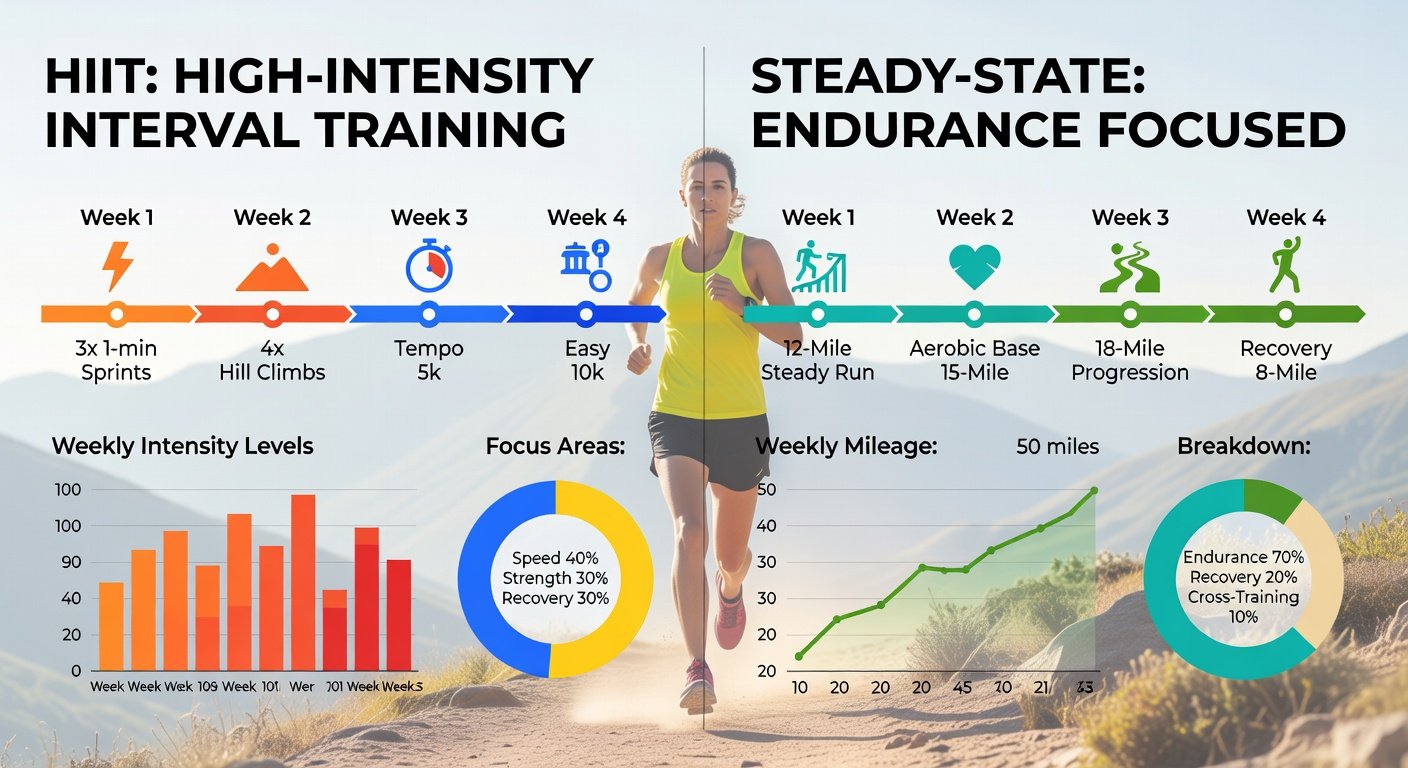
Sample 4-Week HIIT-Focused Plan for Ultras
Assumes 40-60 miles/week base. Include 1-2 rest days. Warm-up/cool-down 10-15 min easy.
| Week | Mon | Tue | Wed | Thu | Fri | Sat | Sun |
|---|---|---|---|---|---|---|---|
| 1 | Rest | HIIT: 6x400m @5K pace, 2min jog | Easy 8mi | Rest | Tempo 6mi | Long 16mi steady | Easy 6mi |
| 2 | Rest | HIIT: 5x800m hills | Easy 9mi | Rest | Intervals: 8x200m | Long 18mi | Easy 7mi |
| 3 | Rest | HIIT: 4x4min @threshold | Easy 10mi | Rest | Tempo 7mi | Long 20mi | Easy 8mi |
| 4 | Rest | HIIT: 10x30sec surges | Easy 8mi | Rest | Recovery 5mi | Long 22mi | Rest |
Total weekly: Ramp to 55 miles. Track HR; adjust for terrain.
Sample 4-Week Steady-State Plan
Focus on volume. Paces: Zone 2 (easy chat).
| Week | Mon | Tue | Wed | Thu | Fri | Sat | Sun |
|---|---|---|---|---|---|---|---|
| 1 | Rest | Easy 10mi | Steady 8mi | Rest | Easy 9mi | Long 20mi | Shakeout 6mi |
| 2 | Rest | Easy 11mi | Steady 9mi | Rest | Easy 10mi | Long 22mi | Shakeout 7mi |
| 3 | Rest | Easy 12mi | Steady 10mi | Rest | Easy 11mi | Long 24mi | Shakeout 8mi |
| 4 | Rest | Easy 10mi | Steady 8mi | Rest | Easy 9mi | Long 26mi | Rest |
Real-World Examples from Elite Ultra Runners
Courtney Dauwalter (MOAB 240 winner) logs 80% steady-state, using HIIT sparingly for speed. Jim Walmsley (multi-Western States champ) incorporates VO2 intervals mid-cycle. Both credit hybrids for success.
Amateur case: A 50K finisher switched 20% HIIT, shaved 45 minutes off PR via better hills.
Decision Flowchart: HIIT or Steady-State?
- Beginner/base phase? → Steady-state priority.
- Experienced, plateaued VO2? → Add HIIT 1-2x/week.
- 4+ weeks from race? → Steady-state dominant.
- Need speed/economy? → HIIT focus, monitor fatigue.
- Hybrid verdict: Yes—80/20 rule.
Common Pitfalls and Recovery Integration
Pitfalls:
- Over-HIIT: Leads to overtraining syndrome.
- Neglect Strength: Pair with core/planks 2x/week.
- Poor Nutrition: Fuel steady runs with carbs/fats.
Recovery: Sleep 8+ hours, foam roll, active recovery runs. Use HRV apps. FAQs below address integration.
FAQs: HIIT vs Steady-State for Ultras
Q: Can HIIT replace long runs? No—use for supplementation.
Q: How to integrate recovery? 48hr gap post-HIIT; easy spins for steady.
Q: Best for 100-milers? Steady-state 85%, HIIT 15% pre-peak.
Q: Track progress? Test 5K time trial or lactate threshold every 4 weeks.
Conclusion: Balance for Ultra Success
Neither HIIT nor steady-state alone builds unbeatable ultra endurance—combine them strategically. Prioritize steady-state for base, HIIT for polish. Track, adapt, and emulate elites like Dauwalter. Your next ultra PB awaits.


No comments yet. Be the first!