 The Runner Story

Introduction to Marathon Pacing in 2026
Marathon runners preparing for 2026 events encounter increasingly competitive fields and demanding courses that reward precise energy management. Pacing stands as the single most important factor separating those who finish strong from those who fade dramatically after mile 18. This comprehensive guide examines the physiological principles behind effective pacing, provides concrete calculation methods, and delivers step-by-step implementation frameworks that athletes can apply immediately in training. Whether your goal is a Boston qualifier or simply completing the distance with strength to spare, mastering these techniques will transform your race experience and improve endurance sustainability across all 26.2 miles.
Understanding the Science of Pacing Splits
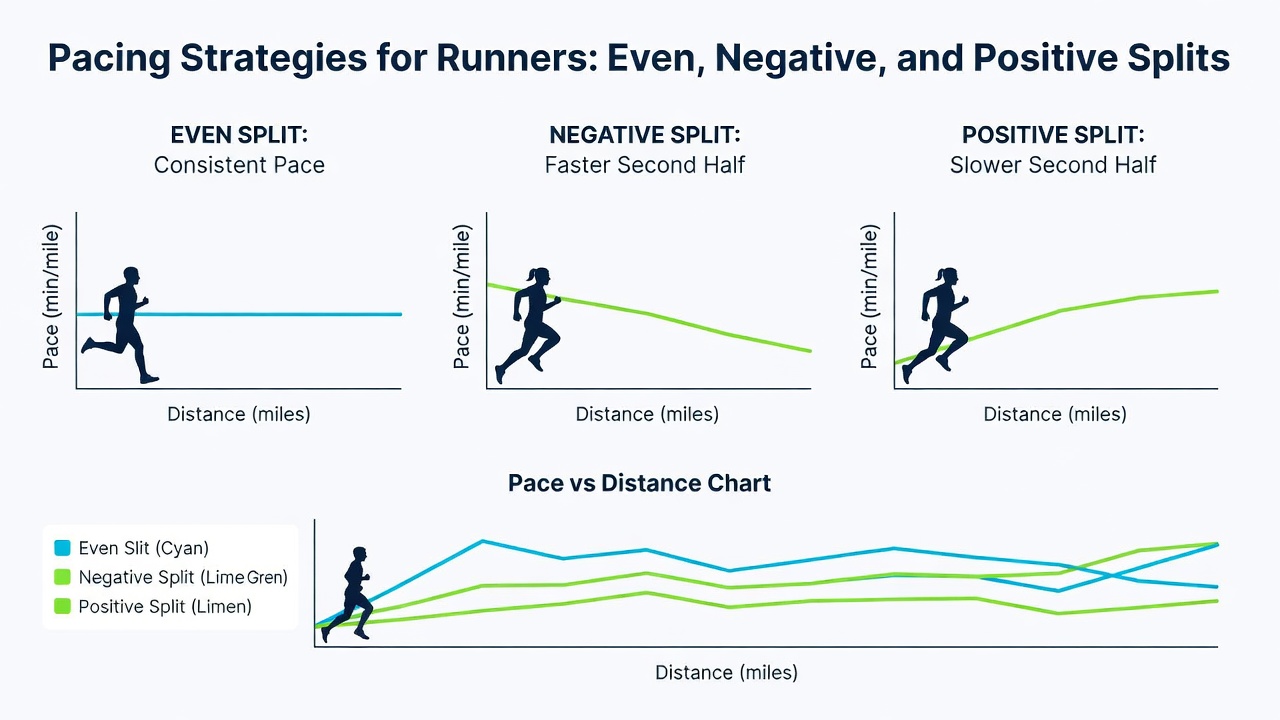
Exercise physiology research consistently demonstrates that pacing strategy directly influences glycogen utilization, lactate threshold maintenance, and overall aerobic efficiency. Even splits maintain identical mile times from start to finish, creating a steady-state effort that minimizes early anaerobic contribution. Negative splits begin conservatively and accelerate in the second half, aligning with the body’s natural ability to sustain higher intensities once warmed up. Positive splits, while common among novices, reflect early overexertion and typically result in significant slowdowns after the halfway point.
Studies published in peer-reviewed journals show that elite athletes who execute negative splits often achieve 3-6% performance gains compared with even-paced efforts of equal perceived exertion. This occurs because early miles at slightly slower speeds preserve muscle glycogen stores for the critical final 10K. Recreational runners can expect similar benefits when they resist the temptation to chase pack leaders in the opening miles.
Real-World Runner Examples
Take Sarah, a 42-year-old masters athlete who improved her marathon time from 4:12 to 3:58 in 2025 by switching to a negative-split plan. She started at 9:15 per mile for the first 10 miles, then progressively dropped to 8:45 by mile 20. Another example comes from club runner Marcus, who attempted an even-split 3:30 goal but finished in 3:42 after starting at 7:45 pace for the first 5K. His experience highlights how even small early deviations compound over the full distance. Multiple case studies from training groups show that runners who practice split-specific long runs three times in the final eight weeks before race day achieve markedly better adherence on event morning.
Calculating Your Target Paces
Begin by converting your goal time into seconds, then divide by 26.2 to establish an average pace. For a 3:45 target this yields approximately 8:35 per mile. Apply a 10-20 second cushion for aid stations, turns, and elevation changes. Use recent race times or time-trial results to set realistic parameters. Incorporate heart-rate zones derived from a recent lactate threshold test so that pace targets remain aligned with sustainable effort rather than arbitrary numbers. Test these calculated paces during at least four long runs of 18 miles or longer, adjusting based on perceived exertion and recovery metrics.
Using GPS Tools for Pacing Adherence
Contemporary GPS devices deliver real-time feedback through mile alerts, virtual pacers, and grade-adjusted pace readings. Garmin’s PacePro feature and Coros’s EvoLab metrics allow runners to program target splits in advance. Cross-reference pace data with heart-rate and cadence metrics to detect early fatigue. In areas with poor satellite reception, such as dense city centers or tree-covered paths, rely on perceived effort and perceived pace rather than instantaneous readings. Post-run analysis on platforms like Strava or TrainingPeaks reveals patterns that inform future adjustments.
Adjusting Pacing for Terrain and Weather
Hilly marathons demand effort-based pacing rather than strict speed targets. On climbs, shorten stride length while keeping heart rate within the prescribed aerobic zone. Descents should feature quick but controlled turnover to avoid excessive eccentric muscle damage. Heat and humidity above 70°F (21°C) and 60% relative humidity warrant slowing goal pace by 15-30 seconds per mile. Headwinds require tucking behind other runners or vehicles when possible, while tailwinds allow slight acceleration on exposed sections. Always preview course elevation profiles and typical race-day weather patterns at least one month prior.
Step-by-Step Implementation Plan
- Conduct a half-marathon time trial four months before race day to establish baseline fitness.
- Design a 16-week macrocycle that includes weekly long runs with embedded pace segments starting at mile 8.
- Incorporate two dress-rehearsal marathons at 75% distance with exact goal pacing and nutrition protocols.
- Practice race-morning routines including warm-up jogs, dynamic stretching, and pre-race fueling on long-run days.
- Schedule three taper weeks with reduced volume but maintained short pace efforts to preserve feel.
- Review weekly training logs and adjust upcoming workouts based on recovery heart rate and sleep quality.
Common Pacing Mistakes to Avoid
- Allowing early adrenaline to push pace more than 15 seconds faster than goal for the first three miles.
- Neglecting mid-race fueling, which depletes glycogen reserves before mile 20.
- Overreacting to minor GPS discrepancies by suddenly changing effort levels.
- Skipping post-long-run recovery protocols that include foam rolling and hydration monitoring.
- Choosing a goal time based on training optimism rather than verified race performances.
Comparison of Popular Pacing Apps
Runna provides AI-driven daily adjustments and live audio cues during runs. Strava’s segment analysis helps identify where pace consistency breaks down. Garmin Connect offers detailed post-activity graphs that highlight split trends. TrainingPeaks supplies power and heart-rate integration for advanced users. Selection depends on device compatibility and the level of coaching feedback desired.
FAQs on Race-Day Adjustments and Recovery Pacing
How should I adjust pacing if conditions change mid-race?
Reassess effort every 5K using heart rate and perceived exertion. If temperature rises unexpectedly, add 10-15 seconds per mile to targets starting at mile 10.
What recovery pacing protocol follows the marathon?
Limit activity to walking for 48 hours, introduce easy cycling or swimming after 72 hours, and resume light running only when soreness subsides. Structured training typically resumes after three to four weeks.
Should I change pacing strategy if I feel unusually strong at mile 18?
Gradually accelerate by no more than 5 seconds per mile while monitoring heart rate to prevent late-race collapse.
Conclusion
Precision pacing converts the marathon from an endurance gamble into a controlled performance. By integrating split science, accurate calculations, terrain-aware adjustments, and disciplined training plans, runners can optimize energy distribution throughout 26.2 miles. Begin incorporating these methods in your next training cycle to experience measurable improvements in 2026. For additional evidence-based resources, consult Runner's World and explore scientific literature at PubMed Central.


No comments yet. Be the first!